" height="5.615400000000001px" id="hIcpieuhS" transform="translate(21.523 16.845)" width="20.586599999999997px"/><path d="M 31.816 5.614 L 31.816 0 L 0 0.002 L 3.742 5.614 Z" fill="rgb(0, 49, 39)" height="5.613800000000001px" id="Miokbz6fW" transform="translate(15.909 28.074)" width="31.815700000000003px"/><path d="M 8.672 2.808 L 10.293 0 L 0 0 L 0 5.615 L 3.811 5.615 C 5.817 5.615 7.67 4.546 8.674 2.808 Z" fill="rgb(0, 49, 39)" height="5.615400000000001px" id="t2CWxRKdG" transform="translate(11.231 22.458)" width="10.2932px"/><path d="M 33.278 8.012 L 25.883 0.617 C 25.489 0.223 24.952 0 24.395 0 L 5.615 0 L 5.615 5.616 L 28.074 5.616 L 28.074 11.231 L 5.615 11.231 C 2.514 11.231 0 13.745 0 16.846 L 0 22.462 C 0 25.563 2.514 28.077 5.615 28.077 L 23.69 28.077 C 24.249 28.077 24.787 27.854 25.184 27.458 C 26.197 26.445 26.923 25.718 28.074 24.568 L 28.074 28.077 L 33.689 28.077 L 33.689 9.008 C 33.689 8.634 33.541 8.278 33.278 8.015 Z M 28.074 22.46 L 5.615 22.46 L 5.615 16.845 L 28.074 16.845 Z" fill="rgb(0, 49, 39)" height="28.0771px" id="ZkIP4hXuu" transform="translate(101.064 11.227)" width="33.68899999999999px"/><path d="M 5.615 0 L 0 0 L 0 28.074 L 5.615 28.074 Z" fill="rgb(0, 49, 39)" height="28.0738px" id="mCKLJMDuZ" transform="translate(213.36 11.229)" width="5.614999999999981px"/><path d="M 5.616 15.971 L 5.616 0 L 0 0 L 0 22.458 L 4.998 17.46 C 5.393 17.066 5.616 16.529 5.616 15.971 Z" fill="rgb(0, 49, 39)" height="22.4583px" id="J3VDH9mds" transform="translate(224.588 11.23)" width="5.616000000000014px"/><path d="M 0 0 L 0 5.615 L 14.037 5.615 L 14.037 28.074 L 19.652 28.074 L 19.652 5.615 L 14.654 0.617 C 14.26 0.223 13.723 0 13.166 0 Z" fill="rgb(0, 49, 39)" height="28.0738px" id="XusuArdlx" transform="translate(174.056 11.229)" width="19.651999999999987px"/><path d="M 14.037 0 L 0 0 L 0 5.615 L 14.037 5.615 Z" fill="rgb(0, 49, 39)" height="5.615399999999999px" id="hjibh6KhB" transform="translate(193.708 11.229)" width="14.037000000000006px"/><path d="M 22.459 0 L 0 0 L 0 5.615 L 22.459 5.615 Z" fill="rgb(0, 49, 39)" height="5.615400000000001px" id="vbgrfQ29I" transform="translate(224.588 33.688)" width="22.459000000000003px"/><path d="M 5.616 15.971 L 5.616 0 L 0 0 L 0 22.458 L 4.998 17.46 C 5.393 17.066 5.616 16.529 5.616 15.971 Z" fill="rgb(0, 49, 39)" height="22.4583px" id="dBOtzGQ5p" transform="translate(252.66 11.23)" width="5.616000000000014px"/><path d="M 22.458 0 L 0 0 L 0 5.615 L 22.458 5.615 Z" fill="rgb(0, 49, 39)" height="5.615400000000001px" id="sBPFKMQpz" transform="translate(252.662 33.688)" width="22.458px"/><path d="M 28.073 11.231 L 5.615 11.231 L 5.615 5.616 L 28.073 5.616 L 28.073 0 L 9.294 0 C 8.736 0 8.2 0.221 7.805 0.617 L 0.411 8.012 C 0.148 8.275 0 8.633 0 9.004 L 0 11.231 C 0 14.332 2.514 16.846 5.615 16.846 L 28.073 16.846 L 28.073 22.462 L 0 22.462 L 0 28.077 L 24.394 28.077 C 24.952 28.077 25.489 27.856 25.883 27.46 L 33.278 20.065 C 33.54 19.803 33.689 19.444 33.689 19.073 L 33.689 16.846 C 33.689 13.745 31.175 11.231 28.073 11.231 Z" fill="rgb(0, 49, 39)" height="28.0771px" id="JqjrKjpDA" transform="translate(140.368 11.227)" width="33.68899999999999px"/><path d="M 26.089 0.822 C 25.563 0.296 24.848 0 24.104 0 L 5.615 0 C 2.514 0 0 2.514 0 5.615 L 0 22.46 L 5.615 22.46 L 5.615 5.615 L 28.074 5.615 L 28.074 22.46 L 5.615 22.46 L 10.613 27.458 C 11.008 27.853 11.544 28.075 12.102 28.075 L 28.074 28.075 C 31.175 28.075 33.689 25.561 33.689 22.46 L 33.689 9.001 C 33.689 8.631 33.542 8.276 33.281 8.014 C 31.497 6.229 26.089 0.822 26.089 0.822 Z" fill="rgb(0, 49, 39)" height="28.075400000000002px" id="K9MOiU9jF" transform="translate(277.927 11.229)" width="33.688999999999965px"/><path d="M 5.615 5.615 L 33.689 5.615 L 33.689 0 L 9.295 0 C 8.737 0 8.2 0.221 7.806 0.617 L 0.411 8.012 C 0.149 8.275 0 8.633 0 9.004 L 0 22.46 C 0 25.561 2.514 28.075 5.615 28.075 L 33.689 28.075 L 33.689 22.46 L 7.02 22.46 C 6.244 22.46 5.617 21.831 5.617 21.057 L 5.617 5.617 Z" fill="rgb(0, 49, 39)" height="28.075400000000002px" id="LADVQXA8x" transform="translate(64.569 11.229)" width="33.6893px"/><path d="M 2.499 10.925 C 1.714 10.422 1.1 9.729 0.661 8.842 C 0.22 7.956 0 6.954 0 5.832 C 0 4.709 0.22 3.707 0.661 2.821 C 1.101 1.936 1.714 1.243 2.499 0.746 C 3.285 0.248 4.186 0 5.203 0 C 6.094 0 6.885 0.175 7.577 0.526 C 8.268 0.878 8.818 1.352 9.227 1.949 C 9.637 2.547 9.888 3.207 9.982 3.93 L 8.504 3.93 C 8.367 3.229 8.045 2.606 7.537 2.067 C 7.029 1.527 6.25 1.256 5.203 1.256 C 4.355 1.256 3.651 1.471 3.097 1.901 C 2.541 2.331 2.133 2.892 1.87 3.583 C 1.608 4.275 1.478 5.024 1.478 5.832 C 1.478 6.639 1.608 7.391 1.87 8.088 C 2.133 8.785 2.541 9.349 3.097 9.778 C 3.653 10.207 4.355 10.424 5.203 10.424 C 6.283 10.424 7.09 10.128 7.625 9.536 C 8.159 8.943 8.453 8.233 8.504 7.405 L 9.982 7.405 C 9.897 8.233 9.651 8.971 9.242 9.621 C 8.833 10.272 8.283 10.777 7.592 11.138 C 6.9 11.5 6.103 11.681 5.201 11.681 C 4.185 11.681 3.283 11.431 2.498 10.927 Z" fill="rgb(0, 49, 39)" height="11.6815px" id="bLAF6G9xs" transform="translate(322.841 22.23)" width="9.981999999999971px"/><path d="M 1.069 10.384 C 0.356 9.666 0 8.705 0 7.499 L 0 0 L 1.414 0 L 1.414 7.499 C 1.414 8.41 1.652 9.09 2.129 9.536 C 2.606 9.981 3.332 10.204 4.306 10.204 C 5.28 10.204 6.006 9.981 6.483 9.536 C 6.96 9.09 7.198 8.412 7.198 7.499 L 7.198 0 L 8.612 0 L 8.612 7.499 C 8.612 8.704 8.256 9.666 7.543 10.384 C 6.83 11.102 5.75 11.462 4.304 11.462 C 2.858 11.462 1.779 11.104 1.066 10.384 Z" fill="rgb(0, 49, 39)" height="11.4619px" id="iuoOSadIH" transform="translate(333.707 22.447)" width="8.612000000000023px"/><path d="M 2.499 10.925 C 1.713 10.422 1.099 9.729 0.66 8.842 C 0.22 7.956 0 6.954 0 5.832 C 0 4.709 0.22 3.707 0.66 2.821 C 1.101 1.936 1.713 1.243 2.499 0.746 C 3.285 0.248 4.186 0 5.203 0 C 6.094 0 6.885 0.175 7.576 0.526 C 8.268 0.878 8.818 1.352 9.227 1.949 C 9.636 2.547 9.887 3.207 9.981 3.93 L 8.504 3.93 C 8.367 3.229 8.045 2.606 7.537 2.067 C 7.028 1.527 6.249 1.256 5.203 1.256 C 4.354 1.256 3.651 1.471 3.097 1.901 C 2.54 2.331 2.133 2.892 1.87 3.583 C 1.608 4.275 1.477 5.024 1.477 5.832 C 1.477 6.639 1.608 7.391 1.87 8.088 C 2.133 8.785 2.54 9.349 3.097 9.778 C 3.653 10.207 4.354 10.424 5.203 10.424 C 6.282 10.424 7.089 10.128 7.624 9.536 C 8.159 8.943 8.453 8.233 8.504 7.405 L 9.981 7.405 C 9.897 8.233 9.651 8.971 9.242 9.621 C 8.832 10.272 8.283 10.777 7.591 11.138 C 6.9 11.5 6.102 11.681 5.201 11.681 C 4.184 11.681 3.283 11.431 2.497 10.927 Z" fill="rgb(0, 49, 39)" height="11.6815px" id="mnOHX8oWu" transform="translate(343.334 22.23)" width="9.980999999999995px"/><path d="M 0 0 L 1.415 0 L 1.415 4.78 L 7.421 4.78 L 7.421 0 L 8.836 0 L 8.836 11.241 L 7.421 11.241 L 7.421 6.036 L 1.415 6.036 L 1.415 11.241 L 0 11.241 Z" fill="rgb(0, 49, 39)" height="11.240700000000004px" id="vgtYcLH2F" transform="translate(354.31 22.447)" width="8.836000000000013px"/><path d="M 0 0 L 1.415 0 L 1.415 11.241 L 0 11.241 Z" fill="rgb(0, 49, 39)" height="11.240700000000004px" id="G3Xr1BiaT" transform="translate(364.789 22.447)" width="1.4150000000000205px"/><path d="M 0 0 L 1.414 0 L 1.414 9.983 L 7.311 9.983 L 7.311 11.241 L 0 11.241 Z" fill="rgb(0, 49, 39)" height="11.240700000000004px" id="nZsPGOHBl" transform="translate(367.838 22.447)" width="7.310999999999979px"/><path d="M 0 0 L 1.415 0 L 1.415 9.983 L 7.311 9.983 L 7.311 11.241 L 0 11.241 Z" fill="rgb(0, 49, 39)" height="11.240700000000004px" id="KXdTx5_0Z" transform="translate(375.703 22.447)" width="7.3110000000000355px"/><path d="M 4.15 0 L 5.738 0 L 9.92 11.241 L 8.395 11.241 L 7.405 8.426 L 2.453 8.426 L 1.463 11.241 L 0 11.241 L 4.152 0 Z M 6.948 7.169 L 4.95 1.304 L 4.919 1.304 L 2.922 7.169 L 6.946 7.169 Z" fill="rgb(0, 49, 39)" height="11.240700000000004px" id="FTgYepd4l" transform="translate(383.095 22.447)" width="9.919999999999959px"/><path d="M 2.436 11.201 C 1.713 10.881 1.139 10.424 0.714 9.826 C 0.29 9.229 0.051 8.516 0 7.689 L 1.477 7.689 C 1.665 9.523 2.793 10.44 4.858 10.44 C 5.802 10.44 6.469 10.259 6.861 9.897 C 7.254 9.536 7.451 9.036 7.451 8.395 C 7.451 7.913 7.345 7.542 7.135 7.279 C 6.926 7.017 6.632 6.816 6.256 6.674 C 5.878 6.532 5.292 6.361 4.494 6.162 C 4.42 6.152 4.311 6.126 4.164 6.083 C 3.398 5.894 2.768 5.7 2.269 5.502 C 1.771 5.302 1.347 4.998 0.995 4.59 C 0.644 4.181 0.469 3.641 0.469 2.971 C 0.469 2.06 0.804 1.335 1.475 0.802 C 2.146 0.267 3.08 0 4.273 0 C 5.541 0 6.551 0.309 7.3 0.928 C 8.05 1.547 8.472 2.422 8.566 3.554 L 7.089 3.554 C 6.984 2.778 6.711 2.199 6.272 1.816 C 5.831 1.433 5.171 1.241 4.291 1.241 C 3.516 1.241 2.931 1.383 2.538 1.666 C 2.146 1.948 1.949 2.362 1.949 2.907 C 1.949 3.348 2.073 3.693 2.319 3.945 C 2.565 4.196 2.867 4.386 3.223 4.511 C 3.58 4.637 4.088 4.779 4.749 4.935 C 5.693 5.155 6.44 5.373 6.997 5.587 C 7.551 5.802 8.014 6.131 8.38 6.57 C 8.746 7.01 8.93 7.601 8.93 8.346 C 8.93 9.331 8.595 10.133 7.923 10.751 C 7.253 11.37 6.251 11.678 4.92 11.678 C 3.988 11.678 3.159 11.518 2.436 11.198 Z" fill="rgb(0, 49, 39)" height="11.678200000000004px" id="aVy3WtkJk" transform="translate(392.572 22.227)" width="8.930000000000007px"/></svg>)

Industrial Blades
Industrial Blades
Recycling and Sustainability
Recycling and Sustainability
The Role of Blades in the Separation of Mixed Materials: From Plastic to Metal
The Role of Blades in the Separation of Mixed Materials: From Plastic to Metal
The Role of Blades in the Separation of Mixed Materials: From Plastic to Metal
The separation of mixed materials is one of the most complex challenges in the recycling and waste processing industries. From plastics and metals to composite materials, ensuring efficient separation requires high-performance cutting tools. In this context, industrial blades play a crucial role, not only because of their precision and durability, but also because of their adaptability to different types of materials and applications.
In this article, we will explore the different types of blades used in the separation of mixed materials, their specific applications and how they help improve industrial processes.
Key Features of Blades for the Separation of Mixed Materials
Blades designed for the separation of mixed materials stand out for their specific properties, which allow them to adapt to cutting challenges in industrial environments. One of their main features is cutting precision, essential for ensuring effective separation of materials such as plastics, metals or composites.
In addition, these blades are made from high-strength materials, such as hardened steels or special coatings, which give them superior durability even under intensive use. Their design includes optimised edges that reduce wear and ensure consistent performance over time.
Another key advantage is their ability to minimise waste, as they produce clean cuts that make subsequent material processing easier. These features make blades for the separation of mixed materials an indispensable tool for efficient and sustainable industrial processes.
Main Applications of Blades for the Separation of Mixed Materials
Blades designed for the separation of mixed materials have a wide range of applications, playing a key role in numerous industrial sectors:
Electronics Recycling and WEEE: Separation of plastics, metals and other components in electronic devices, enabling precise sorting for recycling.
Industrial Waste Processing: Handling composite or multi-layer materials, such as aluminium-laminated plastics or bonded paper, making subsequent treatment easier.
Plastics and Metals Recycling: Sorting plastics mixed with metal waste, such as in multi-layer packaging or end-of-life vehicle (ELV) parts.
Packaging Industry: Separation of hybrid materials used in packaging, optimising their recovery and reuse.
Recovered Materials Production: Separation process to prepare recycled materials with the purity needed to meet the quality standards required for their reintroduction to the market.
Each of these applications highlights the versatility and efficiency of these blades, indispensable for achieving sustainable and optimised processes.
Types of Blades for the Separation of Mixed Materials
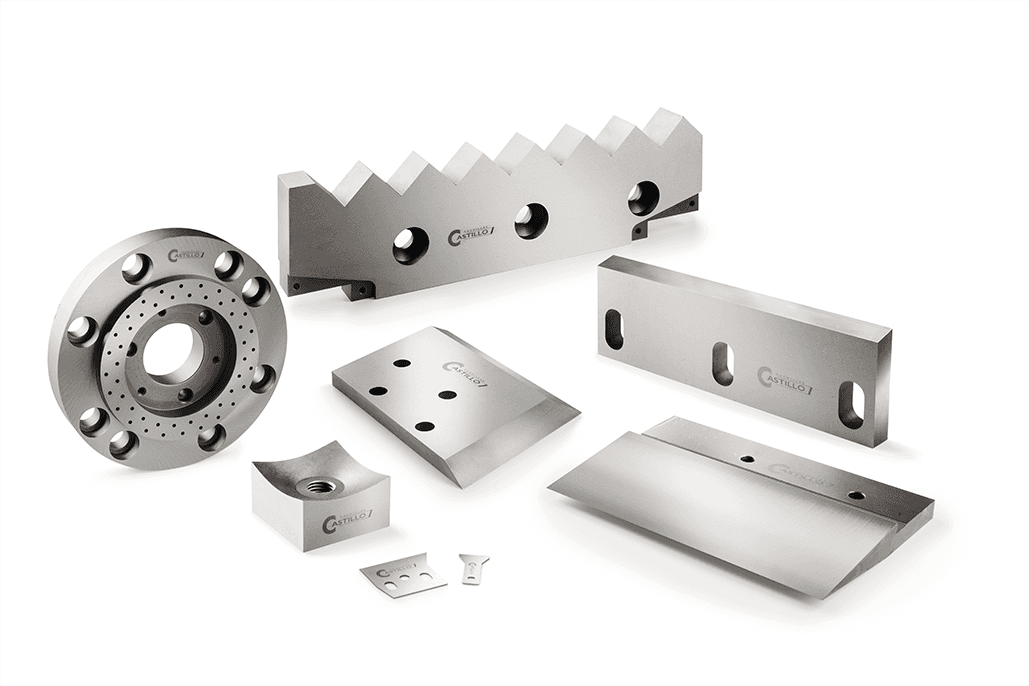
In industrial processes for the separation of mixed materials, such as plastics and metals, blades play an essential role. Each type of blade is designed to meet specific requirements depending on the material and the separation method. Below, we explore the main blades used in this field:
1. Shredding Blades for Density Separators
Used in shredders prior to the density separation process.
Ensure uniform cutting of plastics and metals into manageable fragments that can be separated according to their density.
Materials: hardened steels to withstand wear from abrasive materials.
2. Blades for Air Separators
Designed to cut light materials, such as plastic films or textiles, which will then be separated by air flow.
Help reduce the size of materials, optimising the performance of pneumatic separation systems.
3. Serrated or Saw-tooth Blades
Specialised in handling laminated plastics or composite textiles.
Offer greater control over fragmentation, making mechanical or flotation separation easier.
4. Blades for Mills and Shredders
Reduce bulky materials to precise sizes in order to separate components such as aluminium, copper or plastic.
Common applications: electronic waste and cables.
5. Blades for Cutting Presses in Compaction Processes
Used to separate compacted layers of mixed materials, such as pressed plastics and metals.
Allow clean cuts that make subsequent manual or automated sorting easier.
6. Blades for Magnetic and Electrostatic Separators
Although they do not carry out the separation process itself, these blades work in shredders prior to magnetic or electrostatic sorting, ensuring that the materials arrive at the correct size for separation.
Associated Technologies
The performance of industrial blades in the separation of mixed materials does not depend solely on their design, but also on the technologies that complement their operation. These technologies optimise the process, ensuring precise results and greater efficiency:
Advanced Shredding Systems: Shredding equipment that prepares materials for separation by reducing their size, improving the exposure of individual components.
Density Tables and Air Separators: Technologies that combine blades with density sorting systems or air flow, allowing materials to be separated according to weight and density.
Screening Technology: Applied after cutting, it removes unwanted particles such as dust or smaller residues through the use of vibrating sieves and cyclones.
Automation and Smart Sensors: Integration of advanced sensors that analyse the material in real time, adjusting cutting and separation to maximise precision and reduce waste.
Anti-wear Coatings on Blades: Use of materials such as tungsten carbide or advanced ceramics that extend blade life and maintain their edge in intensive applications.
These technologies work together with the blades to deliver an optimised separation process, aligned with today’s demands for sustainability and operational efficiency.
Cuchillas Castillo: Tailored Solutions for the Separation of Mixed Materials
At Cuchillas Castillo, we design and manufacture specialised industrial blades to meet the challenges posed by the separation of mixed materials in sectors such as recycling and waste processing. Our approach combines precision, durability and customisation, adapting to the specific needs of each customer.
Our solutions stand out for:
Custom Design: Blades adapted to different types of machinery and materials, from plastics and metals to complex composites.
High-Quality Materials: Made with alloy steels and advanced coatings that maximise wear resistance even in intensive applications.
Comprehensive Technical Support: Advice to optimise blade performance in separation systems, reducing downtime and improving operational efficiency.
In addition, we offer complementary services such as maintenance, repair and equipment rebuilding, ensuring that our customers’ operations maintain continuity and productivity.
At Cuchillas Castillo, we design and manufacture industrial blades that adapt to the specific demands of each process, guaranteeing quality, precision and efficiency in every application.
The separation of mixed materials is one of the most complex challenges in the recycling and waste processing industries. From plastics and metals to composite materials, ensuring efficient separation requires high-performance cutting tools. In this context, industrial blades play a crucial role, not only because of their precision and durability, but also because of their adaptability to different types of materials and applications.
In this article, we will explore the different types of blades used in the separation of mixed materials, their specific applications and how they help improve industrial processes.
Key Features of Blades for the Separation of Mixed Materials
Blades designed for the separation of mixed materials stand out for their specific properties, which allow them to adapt to cutting challenges in industrial environments. One of their main features is cutting precision, essential for ensuring effective separation of materials such as plastics, metals or composites.
In addition, these blades are made from high-strength materials, such as hardened steels or special coatings, which give them superior durability even under intensive use. Their design includes optimised edges that reduce wear and ensure consistent performance over time.
Another key advantage is their ability to minimise waste, as they produce clean cuts that make subsequent material processing easier. These features make blades for the separation of mixed materials an indispensable tool for efficient and sustainable industrial processes.
Main Applications of Blades for the Separation of Mixed Materials
Blades designed for the separation of mixed materials have a wide range of applications, playing a key role in numerous industrial sectors:
Electronics Recycling and WEEE: Separation of plastics, metals and other components in electronic devices, enabling precise sorting for recycling.
Industrial Waste Processing: Handling composite or multi-layer materials, such as aluminium-laminated plastics or bonded paper, making subsequent treatment easier.
Plastics and Metals Recycling: Sorting plastics mixed with metal waste, such as in multi-layer packaging or end-of-life vehicle (ELV) parts.
Packaging Industry: Separation of hybrid materials used in packaging, optimising their recovery and reuse.
Recovered Materials Production: Separation process to prepare recycled materials with the purity needed to meet the quality standards required for their reintroduction to the market.
Each of these applications highlights the versatility and efficiency of these blades, indispensable for achieving sustainable and optimised processes.
Types of Blades for the Separation of Mixed Materials
In industrial processes for the separation of mixed materials, such as plastics and metals, blades play an essential role. Each type of blade is designed to meet specific requirements depending on the material and the separation method. Below, we explore the main blades used in this field:
1. Shredding Blades for Density Separators
Used in shredders prior to the density separation process.
Ensure uniform cutting of plastics and metals into manageable fragments that can be separated according to their density.
Materials: hardened steels to withstand wear from abrasive materials.
2. Blades for Air Separators
Designed to cut light materials, such as plastic films or textiles, which will then be separated by air flow.
Help reduce the size of materials, optimising the performance of pneumatic separation systems.
3. Serrated or Saw-tooth Blades
Specialised in handling laminated plastics or composite textiles.
Offer greater control over fragmentation, making mechanical or flotation separation easier.
4. Blades for Mills and Shredders
Reduce bulky materials to precise sizes in order to separate components such as aluminium, copper or plastic.
Common applications: electronic waste and cables.
5. Blades for Cutting Presses in Compaction Processes
Used to separate compacted layers of mixed materials, such as pressed plastics and metals.
Allow clean cuts that make subsequent manual or automated sorting easier.
6. Blades for Magnetic and Electrostatic Separators
Although they do not carry out the separation process itself, these blades work in shredders prior to magnetic or electrostatic sorting, ensuring that the materials arrive at the correct size for separation.
Associated Technologies
The performance of industrial blades in the separation of mixed materials does not depend solely on their design, but also on the technologies that complement their operation. These technologies optimise the process, ensuring precise results and greater efficiency:
Advanced Shredding Systems: Shredding equipment that prepares materials for separation by reducing their size, improving the exposure of individual components.
Density Tables and Air Separators: Technologies that combine blades with density sorting systems or air flow, allowing materials to be separated according to weight and density.
Screening Technology: Applied after cutting, it removes unwanted particles such as dust or smaller residues through the use of vibrating sieves and cyclones.
Automation and Smart Sensors: Integration of advanced sensors that analyse the material in real time, adjusting cutting and separation to maximise precision and reduce waste.
Anti-wear Coatings on Blades: Use of materials such as tungsten carbide or advanced ceramics that extend blade life and maintain their edge in intensive applications.
These technologies work together with the blades to deliver an optimised separation process, aligned with today’s demands for sustainability and operational efficiency.
Cuchillas Castillo: Tailored Solutions for the Separation of Mixed Materials
At Cuchillas Castillo, we design and manufacture specialised industrial blades to meet the challenges posed by the separation of mixed materials in sectors such as recycling and waste processing. Our approach combines precision, durability and customisation, adapting to the specific needs of each customer.
Our solutions stand out for:
Custom Design: Blades adapted to different types of machinery and materials, from plastics and metals to complex composites.
High-Quality Materials: Made with alloy steels and advanced coatings that maximise wear resistance even in intensive applications.
Comprehensive Technical Support: Advice to optimise blade performance in separation systems, reducing downtime and improving operational efficiency.
In addition, we offer complementary services such as maintenance, repair and equipment rebuilding, ensuring that our customers’ operations maintain continuity and productivity.
At Cuchillas Castillo, we design and manufacture industrial blades that adapt to the specific demands of each process, guaranteeing quality, precision and efficiency in every application.
The separation of mixed materials is one of the most complex challenges in the recycling and waste processing industries. From plastics and metals to composite materials, ensuring efficient separation requires high-performance cutting tools. In this context, industrial blades play a crucial role, not only because of their precision and durability, but also because of their adaptability to different types of materials and applications.
In this article, we will explore the different types of blades used in the separation of mixed materials, their specific applications and how they help improve industrial processes.
Key Features of Blades for the Separation of Mixed Materials
Blades designed for the separation of mixed materials stand out for their specific properties, which allow them to adapt to cutting challenges in industrial environments. One of their main features is cutting precision, essential for ensuring effective separation of materials such as plastics, metals or composites.
In addition, these blades are made from high-strength materials, such as hardened steels or special coatings, which give them superior durability even under intensive use. Their design includes optimised edges that reduce wear and ensure consistent performance over time.
Another key advantage is their ability to minimise waste, as they produce clean cuts that make subsequent material processing easier. These features make blades for the separation of mixed materials an indispensable tool for efficient and sustainable industrial processes.
Main Applications of Blades for the Separation of Mixed Materials
Blades designed for the separation of mixed materials have a wide range of applications, playing a key role in numerous industrial sectors:
Electronics Recycling and WEEE: Separation of plastics, metals and other components in electronic devices, enabling precise sorting for recycling.
Industrial Waste Processing: Handling composite or multi-layer materials, such as aluminium-laminated plastics or bonded paper, making subsequent treatment easier.
Plastics and Metals Recycling: Sorting plastics mixed with metal waste, such as in multi-layer packaging or end-of-life vehicle (ELV) parts.
Packaging Industry: Separation of hybrid materials used in packaging, optimising their recovery and reuse.
Recovered Materials Production: Separation process to prepare recycled materials with the purity needed to meet the quality standards required for their reintroduction to the market.
Each of these applications highlights the versatility and efficiency of these blades, indispensable for achieving sustainable and optimised processes.
Types of Blades for the Separation of Mixed Materials
In industrial processes for the separation of mixed materials, such as plastics and metals, blades play an essential role. Each type of blade is designed to meet specific requirements depending on the material and the separation method. Below, we explore the main blades used in this field:
1. Shredding Blades for Density Separators
Used in shredders prior to the density separation process.
Ensure uniform cutting of plastics and metals into manageable fragments that can be separated according to their density.
Materials: hardened steels to withstand wear from abrasive materials.
2. Blades for Air Separators
Designed to cut light materials, such as plastic films or textiles, which will then be separated by air flow.
Help reduce the size of materials, optimising the performance of pneumatic separation systems.
3. Serrated or Saw-tooth Blades
Specialised in handling laminated plastics or composite textiles.
Offer greater control over fragmentation, making mechanical or flotation separation easier.
4. Blades for Mills and Shredders
Reduce bulky materials to precise sizes in order to separate components such as aluminium, copper or plastic.
Common applications: electronic waste and cables.
5. Blades for Cutting Presses in Compaction Processes
Used to separate compacted layers of mixed materials, such as pressed plastics and metals.
Allow clean cuts that make subsequent manual or automated sorting easier.
6. Blades for Magnetic and Electrostatic Separators
Although they do not carry out the separation process itself, these blades work in shredders prior to magnetic or electrostatic sorting, ensuring that the materials arrive at the correct size for separation.
Associated Technologies
The performance of industrial blades in the separation of mixed materials does not depend solely on their design, but also on the technologies that complement their operation. These technologies optimise the process, ensuring precise results and greater efficiency:
Advanced Shredding Systems: Shredding equipment that prepares materials for separation by reducing their size, improving the exposure of individual components.
Density Tables and Air Separators: Technologies that combine blades with density sorting systems or air flow, allowing materials to be separated according to weight and density.
Screening Technology: Applied after cutting, it removes unwanted particles such as dust or smaller residues through the use of vibrating sieves and cyclones.
Automation and Smart Sensors: Integration of advanced sensors that analyse the material in real time, adjusting cutting and separation to maximise precision and reduce waste.
Anti-wear Coatings on Blades: Use of materials such as tungsten carbide or advanced ceramics that extend blade life and maintain their edge in intensive applications.
These technologies work together with the blades to deliver an optimised separation process, aligned with today’s demands for sustainability and operational efficiency.
Cuchillas Castillo: Tailored Solutions for the Separation of Mixed Materials
At Cuchillas Castillo, we design and manufacture specialised industrial blades to meet the challenges posed by the separation of mixed materials in sectors such as recycling and waste processing. Our approach combines precision, durability and customisation, adapting to the specific needs of each customer.
Our solutions stand out for:
Custom Design: Blades adapted to different types of machinery and materials, from plastics and metals to complex composites.
High-Quality Materials: Made with alloy steels and advanced coatings that maximise wear resistance even in intensive applications.
Comprehensive Technical Support: Advice to optimise blade performance in separation systems, reducing downtime and improving operational efficiency.
In addition, we offer complementary services such as maintenance, repair and equipment rebuilding, ensuring that our customers’ operations maintain continuity and productivity.
At Cuchillas Castillo, we design and manufacture industrial blades that adapt to the specific demands of each process, guaranteeing quality, precision and efficiency in every application.
" height="27.8521px" id="ZtKQqXM62" transform="translate(51.048 0)" width="102.10770000000001px"/><path d="M 157.804 27.844 L 157.804 0 L 0 0.008 L 18.56 27.844 Z" fill="rgb(255, 255, 255)" height="27.84389999999999px" id="X8GsbV_Tg" transform="translate(23.201 55.702)" width="157.80429999999998px"/><path d="M 43.014 13.926 L 51.054 0 L 0 0 L 0 27.852 L 18.904 27.852 C 28.851 27.852 38.045 22.547 43.023 13.926 Z" fill="rgb(255, 255, 255)" height="27.852100000000004px" id="TbTBhz4ZE" transform="translate(0 27.851)" width="51.054088281000006px"/></svg>)
Contact
Av. Comarcas del País Valenciano, 63 Pol. Ind. Valencia 2000,
46930 Quart De Poblet, Valencia (Spain)
Cuchillas por uso
Cuchillas por sector
Contact
Av. Comarcas del País Valenciano, 63 Pol. Ind. Valencia 2000,
46930 Quart De Poblet, Valencia (Spain)
Cuchillas por uso
Cuchillas por sector
Cuchillas por uso
Cuchillas por sector
Information
Av. Comarcas del País Valenciano, 63 Pol. Ind. Valencia 2000
46930 Quart De Poblet, Valencia